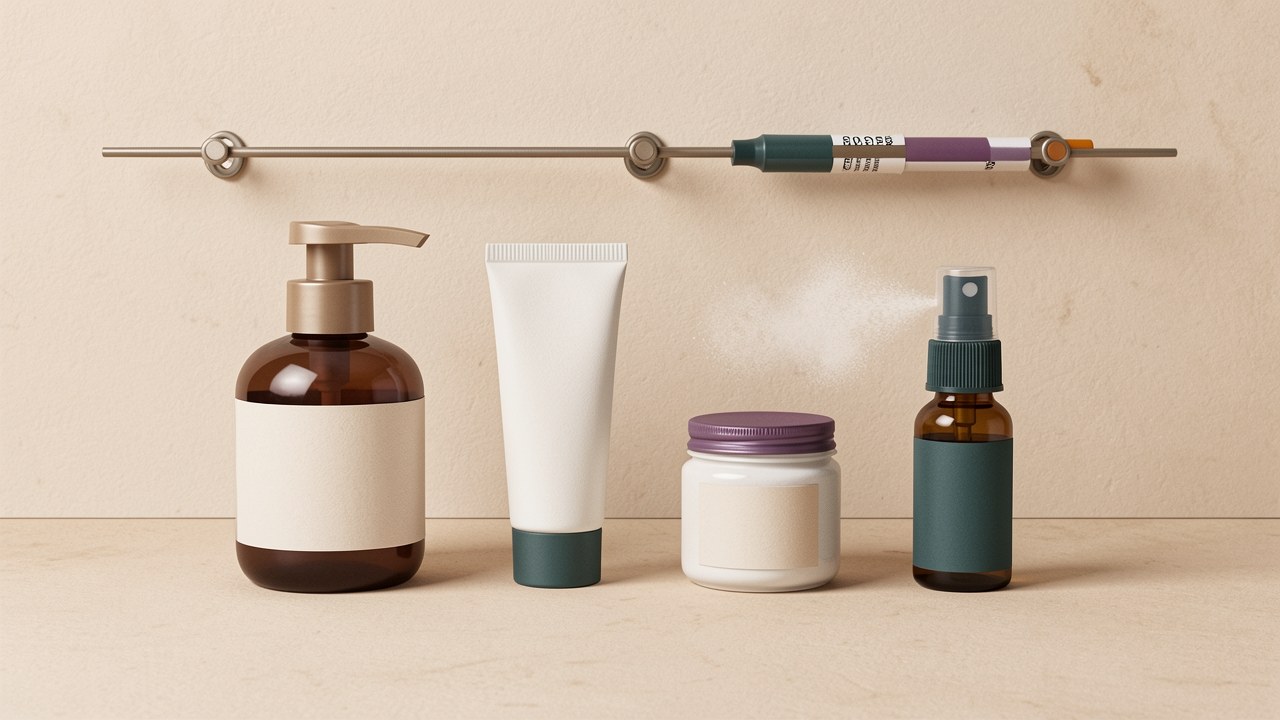
Decide what the routine actually needs to accomplish
A minimal routine is not a smaller version of a maximal one. It is a set of steps chosen because each one does a job you have decided matters. Before removing anything, write down what the routine is for in ordinary language: cleansing without stripping, keeping skin comfortable, managing the main hair concern, and smelling the way you want to smell. If a step cannot be tied to one of those purposes, it becomes a candidate for removal.
A useful framing from practitioner-style minimalist advice is to focus on daily habits done consistently and to prioritize quality over quantity rather than chasing a long product list. That same source notes that overloaded routines are harder to stay consistent with and can cost more than necessary; treat that as editorial reasoning, not a measured finding, but it matches how most people experience a crowded shelf.
- Name your purposes: cleansing, moisturizing, sun protection when outdoors, one hair concern, one scent preference.
- Write each purpose as a plain sentence a friend would understand.
- Mark any step that does not map to a purpose — these are your first removal candidates.
- Decide your realistic effort level on a bad morning, not an ideal one.
Sources: Brilliance Beauty
Audit current products by role rather than by name
Brand names and packaging distract from the real question: what job does this item perform? Sort everything you own by role — cleanse, moisturize, protect, treat, style, scent — and then sort each role into Keep, Maybe and Goodbye piles. Minimalist practitioner guidance describes exactly this three-pile audit and limits the Keep pile to products used at least a few times per week.
Roles are more portable than products. A cream cleanser and a gel cleanser occupy the same role; a leave-in conditioner and a hair oil may overlap heavily. When you see two items in one role, you are looking at a substitution decision rather than a reason to keep both.
Keep the audit physical. Pull products out of drawers and line them up by role. Items you cannot remember using, cannot name a role for, or keep only because they were expensive belong in Maybe or Goodbye, not Keep.
- Group by role first, brand second — or not at all.
- Apply the frequency test: used at least a few times per week earns Keep.
- Flag duplicates inside a role for a later elimination round.
- Check what is expired, separated, or smells off before you decide anything else.
Sources: Brilliance Beauty, Raising Simple
Rank steps by value and interchangeability
Once products are grouped by role, rank the roles themselves. The roles that show up every day and are hard to substitute deserve the top spots; roles that are occasional, optional, or easily covered by another item drop down. This ranking is an editorial judgment built from product-role definitions, not a formulation rule.
Interchangeability is where minimal routines gain most of their ground. A co-wash is described in beauty media as a conditioner that gently removes oil and dirt build-up without heavy detergents, which positions it where a shampoo and a conditioner might otherwise sit; the same source distinguishes it from a 2-in-1 shampoo-and-conditioner hybrid. A wipe-off cleansing lotion is described as not requiring a follow-up moisturizer, toner, or essence step. Dual-purpose body-and-hair mists are positioned as covering scent for both. Each example shows one item absorbing more than one role.
Treat these as substitution options to investigate, not as universal upgrades. Whether a co-wash suits your scalp, or a cleansing lotion leaves your skin comfortable, depends on your own hair and skin — the sources describe product roles, not outcomes for every user.
- Rank by daily frequency first, then by how hard the role is to replace.
- Prefer one item that covers two adjacent roles over two items that each cover one.
- Keep treatment steps as later additions rather than core members of the short list.
| Rank | Role | Why it ranks here | Common substitution option |
|---|---|---|---|
| 1 | Cleanse | Daily and foundational; everything else sits on top of it | Co-wash or wipe-off cleansing lotion where suited |
| 2 | Moisturize / condition | Daily comfort role for skin and hair lengths | Cleansing lotion described as not needing a follow-up moisturizer |
| 3 | Protect | Sun exposure and heat styling both create a protection job | Tinted SPF can carry coverage and protection together |
| 4 | Treat | Targeted, often occasional, and the easiest to defer | Add later rather than at the start |
| 5 | Style | Determined by your one or two signature looks | One styling product aimed at the main concern |
| 6 | Scent | Preference-driven, not coverage-driven | A dual-purpose body-and-hair mist |
Sources: Brilliance Beauty, Into The Gloss, TrendHunter
Build the short list for skin, hair and scent
For skin, salon editorial guidance describes a minimal morning as a gentle cleanser, a lightweight moisturizer, and broad-spectrum SPF 30 or higher, and a minimal evening as makeup remover or cleansing balm if makeup was worn, a gentle cleanser, and moisturizer. Vitamin C serum and retinol are placed in the extras category to add later rather than essentials — that is editorial structure, not dosage or scheduling guidance.
For hair, the same line of advice says most people need a scalp-suited shampoo, a conditioner for the lengths, and one styling product addressing the main concern, whether that is frizz control, volume, curl definition, or heat protection. Choosing one or two signature styles, such as a smooth blowout, a simple ponytail or bun, or natural curls with defined shape, keeps styling decisions small.
For scent, a dual-purpose body-and-hair mist covers both in one item. A 2014 retailer editorial describes hair fragrance as formulated with a small amount of oil and a lower alcohol level than regular perfume, lighter than normal perfume, and intended to be worn on its own rather than layered with the wearer's usual perfume. Read that as a dated positioning statement rather than a formulation rule, and note that fragrance can be a sensitivity trigger for some people — a brand executive quoted in trade press said about 75 percent of consumers report interest in fragrance suitable for sensitive skin, though the underlying survey is not detailed.
- Skin: gentle cleanser, lightweight moisturizer, broad-spectrum SPF 30 or higher in the morning.
- Skin, evening: makeup remover or cleansing balm when needed, gentle cleanser, moisturizer.
- Hair: scalp-suited shampoo, conditioner for the lengths, one styling product for your main concern.
- Hair: pick one or two signature styles so the styling product has a defined job.
- Scent: one fragrance item, possibly a body-and-hair mist, rather than a layered wardrobe.
Sources: Brilliance Beauty, Beauty Bridge, Beauty Independent
Test the minimal routine for two weeks
Two weeks is a commonly used trial length. A first-person account of an elimination experiment describes pulling roughly 80 percent of beauty products out of the routine for at least a couple of weeks and boxing them out of sight. That is one person's practice, not a comparison of testing durations, so treat two weeks as a workable default rather than an evidence-based optimum.
Boxing removed products rather than discarding them is the important mechanic: it makes the trial honest while keeping the decision reversible. That same account reports that the author typically used only what had been touched in the last two weeks and did not miss most of the boxed items — again, a single anecdote rather than a general finding.
During the trial, keep a short log. Note whether any role feels uncovered, whether a product caused obvious discomfort, and whether the routine actually happened on ordinary weekdays. The point of the trial is to find gaps, not to prove that fewer steps is always better.
- Write down the short list you intend to run for two weeks, one line per role.
- Box everything else and put the box out of sight so the trial is genuine.
- Run the short list on ordinary days, including the busy ones.
- Log gaps, discomfort, and skipped steps as they happen rather than from memory.
- At the end of the trial, decide per role whether to keep, adjust, or return an item.
Sources: Raising Simple
Know when to add a step back
A minimal routine earns its place by covering the roles you named at the start. Add a step back when a specific role is visibly uncovered — not when a new product looks appealing. Practitioner guidance proposes three pre-purchase questions that work well here: does a product you already own do the job, will you use the item at least three to four times per week, and does it solve a real problem rather than a fear of missing out.
Additions also make sense around genuine changes: a new season, a new climate, a new water supply, or a new service from a salon or spa professional. A first-person account notes that the same bar soap behaved differently depending on local water conditions, which is a reminder that routines are partly environmental rather than purely product-driven.
Salon editorial advice suggests letting professionals handle more complex treatments — regular trims, gloss or toning services, facials, lash or brow services — as a way to keep the at-home product list short. That source has an obvious commercial interest in services, so read it as editorial advice rather than a neutral recommendation.
Minimalism is also easier to sustain incrementally. The same editorial guidance recommends finishing existing products before buying more, replacing items with simpler multitasking options over time, and reviewing the routine every few months.
- Add back when a named role is genuinely uncovered, not when a product is novel.
- Ask whether an owned product already does the job.
- Ask whether you will use it at least three to four times per week.
- Ask whether it solves a real problem rather than a feeling of missing out.
- Review the whole routine every few months, and finish what you own before buying more.
Sources: Brilliance Beauty, Raising Simple
What to do with the products you remove
The elimination method ends with a box of items you did not use. A first-person account reports donating most if not all of the boxed, unopened products after the trial.
For opened items, the practical sequence is to check whether anything in the box still has a role you later decide to add back, then decide what to pass on and what to discard. The point of holding the box rather than clearing it immediately is that the trial stays reversible for its full length.
Keeping removal reversible also protects against overcorrecting. If a role turns out to be genuinely needed, the item you already own is waiting rather than lost, and you avoid repurchasing something you never needed to replace.
- Keep the removal box intact for the full trial period.
- Donate unopened items where local donation accepts them.
- Check opened items for expiry, separation, or off smells before deciding.
- Return anything from the box to the short list only when a role is genuinely uncovered.
Sources: Raising Simple
Where most minimal routines stall
The common failure is buying the minimal routine instead of reducing to it. A new short list of freshly purchased multitaskers is still a purchase decision, and the reduction-first method works because it starts from what you already own.
The second stall is treating a substitution as a guarantee. A co-wash described as removing build-up without heavy detergents, a wipe-off cleansing lotion described as not needing a follow-up moisturizer, or a dual-purpose body-and-hair mist each describe a product role — not a promise that the swap will suit every scalp, skin type, or fragrance preference.
The third stall is frequency drift. Ranking only works if the top roles actually run most days. If your log shows that the ranked number one role keeps getting skipped, the ranking is describing an aspiration rather than your routine, and the short list should be rebuilt around what genuinely happens.
- Reduce from what you own before adding replacements.
- Treat substitution examples as role descriptions, not guarantees.
- Rebuild the ranking if your log shows the top roles being skipped.
Sources: Brilliance Beauty, Into The Gloss, TrendHunter
Market context: why simpler routines are getting attention
Reported industry figures give some context for why value scrutiny is part of this conversation. An industry research report describes the global beauty industry as a $441 billion market showing signs of cooling after growing about 7 percent annually from 2022 to 2024, and projects roughly 5 percent annual growth through 2030. Those are reported and projected figures from an industry report, not audited statistics.
The same report says 75 percent of surveyed beauty executives expect consumer scrutiny of perceived value to be the biggest theme shaping the industry, and that 54 percent identified uncertain consumer appetite or restricted spending as the greatest risk to growth. Those survey results are reported at the executive level and the underlying methodology is not detailed in the material available here.
Category data reported in trade press adds a texture note. Circana figures quoted in trade press describe prestige hair care as the fastest-growing prestige beauty category, with first-quarter sales up 10 percent versus 7 percent each for fragrance and skin care and 2 percent for makeup, and full-year 2025 prestige hair-care sales up 8 percent versus 5 percent for fragrance, 3 percent for skin care, and 4 percent for makeup. The same reporting describes a high-low pattern in which shoppers may buy shampoo and conditioner in mass while buying treatment products in prestige — a description of shopping behavior, not a prescription for a minimal routine.
- Industry report figures describe market scale and projected growth; they are not audited statistics.
- Survey results about executive expectations are attributed to the report that published them.
- Trade-press category figures come from market research quoted in press, with methodology not reproduced.
- Reported high-low shopping behavior describes what shoppers do, not what a routine should contain.
Sources: McKinsey & Company and The Business of Fashion, Beauty Independent
Frequently asked questions
Can one fragrance product cover both body and hair use?
Dual-purpose body-and-hair mists exist and are positioned as covering scent for both, so a single item can serve that role if you like how it wears. A 2014 retailer editorial describes hair fragrance as formulated with a small amount of oil and a lower alcohol level than regular perfume, lighter than normal perfume, and intended to be used on its own rather than layered with the wearer's regular perfume. Treat that as a dated positioning statement rather than a formulation rule. Fragrance can also be a sensitivity trigger for some people; a brand executive quoted in trade press said about 75 percent of consumers report interest in fragrance suitable for sensitive skin, though the underlying survey source is not detailed, so patch-testing an unfamiliar fragrance is a reasonable personal precaution rather than a rule drawn from these sources.
Sources: Beauty Bridge, TrendHunter, Beauty IndependentHow many steps count as minimal without losing coverage?
There is no universal number. The practical answer is one step per role you named as necessary. Practitioner-style guidance describes a minimal morning as a gentle cleanser, a lightweight moisturizer, and broad-spectrum SPF 30 or higher, and a minimal evening as makeup remover or cleansing balm when makeup was worn, a gentle cleanser, and moisturizer. The same guidance says most people need a scalp-suited shampoo, a conditioner for the lengths, and one styling product addressing the main concern, plus one or two signature styles. Counting roles rather than products keeps the list short without abandoning coverage.
Sources: Brilliance BeautyWhat should I do with products I remove from the routine?
Box them rather than discarding them at the start, so the trial stays reversible. A first-person account of an elimination experiment describes boxing roughly 80 percent of beauty products out of sight for at least a couple of weeks and later donating most if not all of the unopened items. That account addresses unopened products only; for opened items, check for expiry, separation, or off smells and follow local donation guidance where it applies. Keeping the box intact for the full trial also means anything you decide to add back is already on hand.
Sources: Raising SimpleDo multifunctional products have real formulation trade-offs?
There are no documented formulation trade-offs in the material available for this page, so any blanket claim that multitaskers reduce active concentration or hit stability limits would be speculation. What is described are product roles: a co-wash as a conditioner that gently removes oil and dirt build-up without heavy detergents, a wipe-off cleansing lotion as not requiring a follow-up moisturizer, toner, or essence step, and dual-purpose body-and-hair mists covering scent for both. Treat these as descriptions of what a product type is positioned to do, then judge whether it suits your own skin, scalp, and preferences.
Sources: Into The Gloss, TrendHunterHow do I decide which steps to drop first?
Drop by role and frequency. Practitioner guidance describes a three-pile audit — Keep, Maybe, Goodbye — with the Keep pile limited to products used at least a few times per week. Anything that does not map to a purpose you named, or that duplicates another item in the same role, is an early removal candidate. Treatment-type steps that the same guidance places in the extras category, such as vitamin C serum and retinol, are natural later additions rather than core members of a short list.
Sources: Brilliance BeautyIs two weeks the right trial length?
Two weeks is a commonly used trial length rather than a proven optimum. A first-person account describes removing about 80 percent of products for at least a couple of weeks and boxing them out of sight. No source compares testing durations, so treat two weeks as a workable default you can shorten or extend. What matters more than the exact length is logging gaps and skipped steps during the trial so the decision at the end is based on what happened rather than on memory.
Sources: Raising SimpleWhen is it worth adding a step back?
Add a step back when a role you named is visibly uncovered, not when a new product looks appealing. Practitioner guidance proposes three pre-purchase questions that fit this decision: does a product you already own do the job, will you use the item at least three to four times per week, and does it solve a real problem rather than a fear of missing out. Changes in season, climate, water supply, or a salon or spa service can also justify an addition. The same guidance recommends finishing existing products before buying more and reviewing the routine every few months.
Sources: Brilliance Beauty, Raising SimpleDoes a shorter routine have to mean fewer categories of product?
Not necessarily. The reduction-first method shortens by role rather than by category count, and one item can absorb adjacent roles. A conditioning cleanser can cover cleansing and conditioning, a wipe-off cleansing lotion can be described as removing the need for a separate follow-up moisturizer step, and a dual-purpose body-and-hair mist can cover scent for both. Reported industry figures also show that shoppers mix price tiers within a category — trade-press reporting of market research describes buying shampoo and conditioner in mass while buying treatment products in prestige — which is a shopping pattern rather than a rule for how short a routine should be.
Sources: Into The Gloss, TrendHunter, Beauty IndependentSources
- The State of Fashion: Beauty (June 2025) — McKinsey & Company and The Business of Fashion
- Minimalist Beauty Routine: Simple Steps That Work — Brilliance Beauty
- A Minimalist Beauty and Bath Routine - Raising Simple — Raising Simple
- The Only 3 Beauty Products You Need | Into The Gloss — Into The Gloss
- Summer Trend – Hair Fragrance | the Beauty Bridge Connoisseur — Beauty Bridge
- Niacinamide-Infused Hair Mists : Body & Hair Fragrance Mist — TrendHunter
- Odele Steps Into Fragrance With Natural Hair And Body Mists On The Path To $100M | Beauty Independent — Beauty Independent
- How Haircare Became Prestige Beauty's Hottest Category | Beauty Independent — Beauty Independent