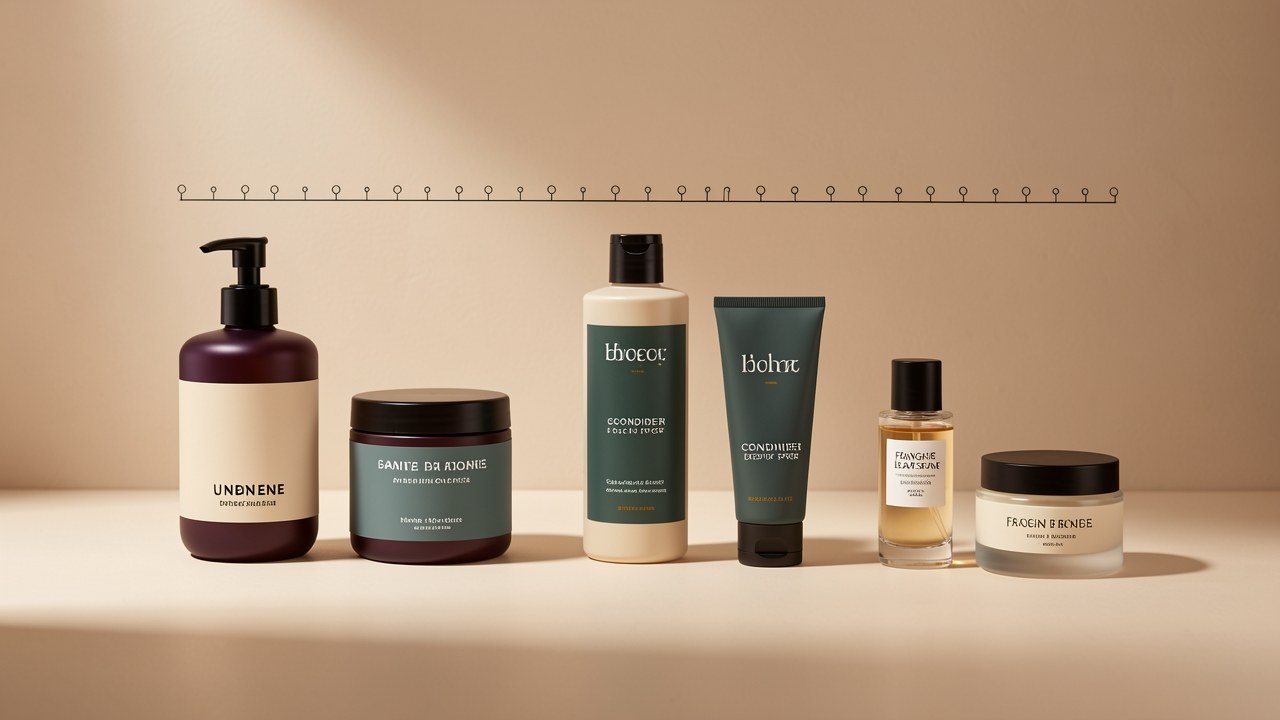
the three categories covers
The three categories in this guide are broad commercial groupings rather than legal definitions. In the United States, the industry that primarily sells cosmetics, perfumes, toiletries and personal grooming products is classified as Beauty, Cosmetics & Fragrance Stores under the code NAICS 44612, which covers beauty supply stores, specialty cosmetics stores and fragrance stores.
A common e-commerce taxonomy separates skin care, makeup, hair care, fragrance, personal care, and tools and devices, then splits hair care into cleansing, treatment, styling and colour. Your own cabinet does not have to follow that tree, but knowing it helps explain why a serum and a styling spray sit in different branches.
- Beauty products and cosmetics: colour and complexion items such as makeup, plus the skin-care items that sit alongside them in a retailer's beauty aisle.
- Hair-care products: cleansing products such as shampoo, conditioners, and dry shampoos or oil-control agents, as well as treatments, styling aids and colour.
- Fragrance products: products whose primary purpose is scent, grouped by concentration such as eau de parfum, eau de toilette, body mist and cologne.
- Cross-over items: body and hair mist, combined hair-and-body wash, and similar products that could sit in more than one branch.
Sources: IBISWorld, Cosmetic Science, Ulta Beauty, WISEPIM
Where the three categories overlap in a routine
The overlaps are real, and they are usually about application area and purpose rather than about which aisle a product sits in. Retailers do not even agree with each other: one large US retailer lists body and hair mist under body care rather than hair care, while another brand's hair-care collection includes a combined hair-and-body wash and a hair mist. That inconsistency is normal, and it is a useful reminder that the label on the shelf is a merchandising decision, not a rule about use.
Fragrance also overlaps with hair care inside the product itself. Ingredient suppliers describe hair-care solutions that combine ingredient expertise with scent engineering to improve lather bloom and long-lasting fragrance, which confirms that fragrance ingredients are part of many hair-care formulations. Trade coverage of hair care likewise notes fragrance positioned as a feature, and fragrance-free versions offered as an alternative.
- A product's category is generally assigned by what it does and where it is applied, while brand is treated as an attribute rather than a category.
- Multi-purpose products are commonly filed under their primary function, with secondary use handled through tags or cross-merchandising rather than a separate multi-purpose category.
- A hydrating facial mist can be filed under face care even if someone occasionally uses it on hair; the primary function decides the shelf.
Sources: Ulta Beauty, WISEPIM, IFF, WWD (Women's Wear Daily), Yves Rocher USA
where to start
If you are staring at a crowded shelf and not sure what belongs where, start with a short written list rather than a shopping list. Write down the single job you want each product to do in the order you would use it. This is not a validated best practice, but it is a practical way to expose duplicates and gaps before you buy anything else.
Sort first by whether the product is rinsed off or left on, then by where it goes. Rinse-off cleansing products and leave-on conditioning and styling products behave differently in a routine, and separating them on paper usually makes the next decision obvious. Fragrance is easiest to place last when you think in layers, though the best placement for you may depend on how the products you own are formulated and how you want the scent to sit.
- List each product you currently use and the job you want it to do.
- Mark it as rinse-off or leave-on.
- Mark the area it is meant for: hair, face, body, or scent.
- Put the list in the order you would actually apply it.
- Circle anything that appears twice in the same role, and start there.
Sources: Cosmetic Science, WISEPIM, Yves Rocher USA
How product formats differ and when a format matters
Format is the physical form a product takes: shampoo versus dry shampoo, serum versus oil, spray versus cream, bar versus bottle. Format matters because it changes how the product is used and how much of it you need per application, and it also changes how strongly a fragrance impression may come through in a leave-on versus a rinse-off step. It does not automatically change which category the product belongs to.
The US hair-care market has shifted toward treatment formats, with one industry executive quoted in trade coverage saying the number-one format is now treatments rather than the classic shampoo-and-conditioner pair. That is an observation about the market, not a recommendation about your shelf. Separate products are not automatically better than combined ones, and combined ones are not automatically enough; the honest answer is that format should follow the job you want done.
| Product type | Usual format | Rinse-off or leave-on | Typical role in a routine |
|---|---|---|---|
| Shampoo | Liquid, bar, paste | Rinse-off | Cleansing step |
| Conditioner | Cream, lotion | Rinse-off | Conditioning step after cleansing |
| Dry shampoo or oil-control product | Aerosol, powder | Leave-on | Refresh or absorb oil between washes |
| Treatment (mask, serum, oil, leave-in) | Cream, liquid, oil, mist | Usually leave-on; masks may be rinsed | Targeted follow-up step |
| Styling product (spray, gel, mousse, heat protectant) | Spray, gel, foam, cream | Leave-on | Finishing or hold step |
| Fragrance (eau de parfum, eau de toilette, body mist, cologne) | Spray, mist | Leave-on | Scent step, often last |
Sources: Cosmetic Science, WISEPIM, WWD (Women's Wear Daily)
Common coordination mistakes
The most frequent mistake is treating the label as a rule. A product merchandised under body care can be perfectly reasonable on hair, and the reverse is also true; the retailer's aisle is one company's organisational choice, not a constraint on how you use what you own.
The second is duplicating a job without noticing. Two different leave-on treatments may be doing nearly the same thing, and adding a third rarely clarifies the picture. The third is buying by category instead of by job, which is how a shelf ends up with several products that all claim the same role and nothing for the role that was actually missing.
- Assuming fragrance always belongs first or last without testing how your own products layer.
- Treating a multi-use product as a full substitute for a dedicated one without checking whether it actually covers the job.
- Rebuilding the whole routine at once so you cannot tell what changed what.
- Buying a product because it fills a category gap rather than a real task gap.
Sources: Ulta Beauty, WISEPIM, Yves Rocher USA
When to reduce products instead of adding more
Reduction makes sense when the routine has more steps than the list of jobs it is supposed to cover. If two products share the same job, the same area, and the same leave-on or rinse-off behavior, one of them is likely redundant for your purposes. That is not a claim that one product is better; it is a bookkeeping observation about duplication.
This is also where multi-purpose products enter honestly. In a product catalogue they are typically filed under a primary function, and a combined hair-and-body wash is a real example merchandised inside a hair-care collection. Whether that is enough for you is a judgement call about coverage, not a researched fact.
- Reduce when the routine has two products doing the same job for the same area.
- Reduce when a step has not changed anything you can observe over several uses.
- Keep the step when it covers a job nothing else on the shelf covers.
- Change one product at a time so the effect of the change stays legible.
Sources: WISEPIM, Yves Rocher USA
Order, timing and frequency as the three decisions
A routine is really three separate decisions, and mixing them up is what makes coordination feel harder than it is. Order is which step comes before which. Timing is how long you wait, if at all, between steps. Frequency is how often the step happens across a week.
Order and frequency can be reasoned about more concretely: rinse-off steps precede leave-on steps by nature, and frequency is the decision that keeps a routine from becoming a daily obligation for every product you own. None of this is medical or safety guidance; it is coordination bookkeeping.
- Decide order first: rinse-off steps, then leave-on steps, with scent generally placed near the end when you layer.
- Decide timing second: how long, if at all, you wait between steps.
- Decide frequency third: which steps happen daily, which happen weekly, and which happen only when needed.
- Review the three decisions separately when something feels off, because the problem is often in frequency rather than in the product.
Sources: Cosmetic Science, WISEPIM, Yves Rocher USA
Frequently asked questions
Do I need products from all three categories for a complete routine?
No. The three categories are commercial groupings, not a required checklist. A complete routine is better defined by which jobs it covers for your hair, skin and scent preferences than by whether every category is represented. Fragrance in particular is optional; it is a category because retailers and catalogues group products that way, not because a routine requires one.
Sources: IBISWorld, WISEPIMShould fragrance go on before or after other products?
There is no single rule that fits every combination of products. A practical starting point is to treat fragrance as a late leave-on step, so that it sits on top of the finished layers rather than under a rinse-off step that would remove it. Beyond that, placement interacts with how the specific products you own are formulated and with how you want the scent to wear, so it is worth testing on your own shelf rather than following an absolute order.
Sources: Cosmetic Science, WISEPIMWhich category should I change first when something is not working?
Change the product whose job is most directly tied to the problem, and change only one thing at a time. Start by writing down what each product is supposed to do; the change you need is usually visible on that list, either as a duplicated job or as a job nothing is covering.
Sources: WISEPIMAre multifunctional products a reasonable substitute for separate ones?
That depends on whether the combined product actually covers the job you wanted, which is a judgement about coverage rather than a fact that can be looked up. In product catalogues, multi-purpose items are usually assigned to their primary function and their secondary use is handled through tags, which is an organisational convention and not a statement about performance. A combined hair-and-body wash is a real example of a product merchandised inside a hair-care collection. Whether it replaces two separate products for you is your call.
Sources: WISEPIM, Yves Rocher USAHow often should a routine be reviewed?
There is no supported interval for reviewing a routine. A reasonable trigger is a change in the list itself: when you add a product, when you notice two products doing the same job, or when the routine has more steps than the jobs it covers. Treat the review as an occasional bookkeeping task rather than a scheduled obligation.
Sources: WISEPIMSources
- Beauty, Cosmetics & Fragrance Stores in the US Industry Data and Analysis — IBISWorld
- Hair Care Products In Cosmetic Science — Cosmetic Science
- Hair Care, Styling & Hair Color Products | Ulta Beauty — Ulta Beauty
- Beauty & Personal Care Product Categories | WISEPIM — WISEPIM
- Beauty & Personal Care - Hair Care Solutions — IFF
- The 2025 100 Greatest Hair Products of All Time — WWD (Women's Wear Daily)
- Hair Care Products — Yves Rocher USA