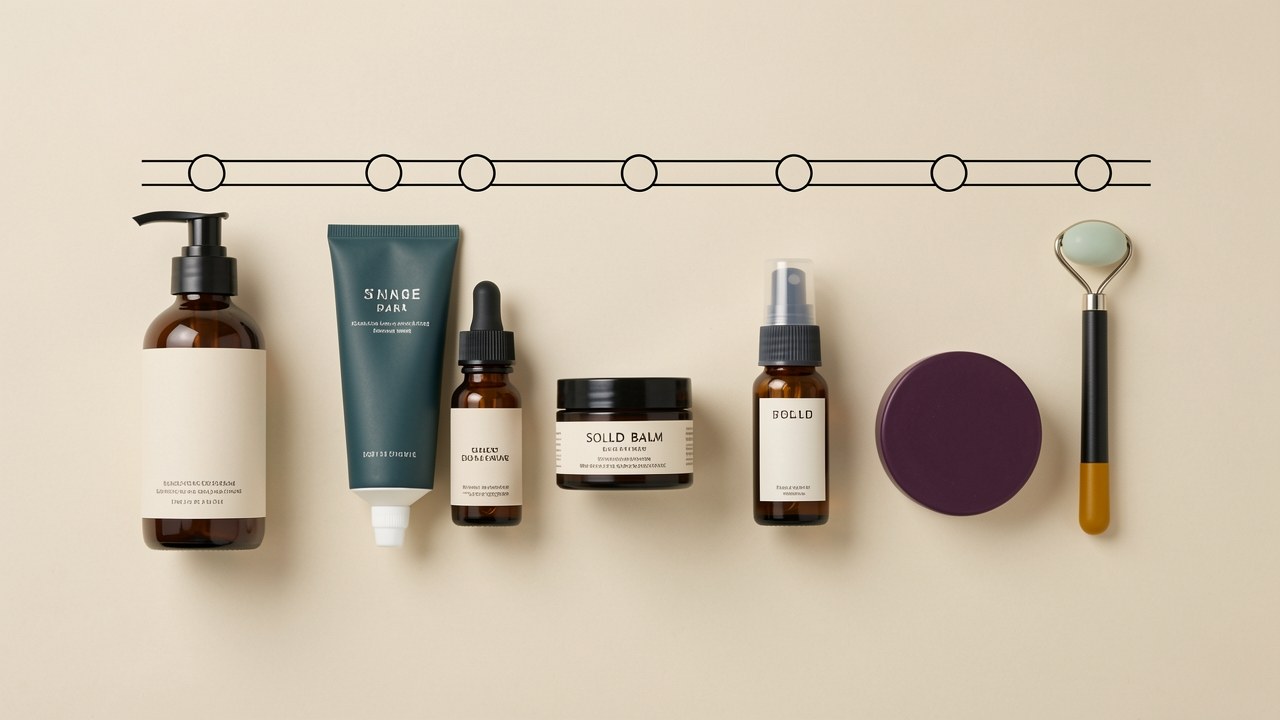
How to read a product format beyond marketing names
A product format is the physical and functional shape of a product: a rinse-out wash, a leave-on liquid, a cream, an oil, a spray or a solid. Marketing names sit on top of that shape, and the same word can mean different things across categories. A serum in skincare is usually a lightweight leave-on liquid applied before a richer layer; a serum in hair care is a different product with different expectations.
The most reliable way to read a format is to ask three questions. First, is it rinsed off or left on? Second, where on the body is it meant to go? Third, what job does it perform — cleansing, conditioning, moisturizing, scenting or something else? Those three answers separate formats more reliably than the words on the front of the package.
Format naming and legal category are also separate ideas. In the United States, a product intended to affect the structure or function of the body, or to treat or prevent disease, is classified as a drug rather than a cosmetic even when applied topically, and a single product can be both. That is why some skincare items carry a Drug Facts panel and others do not. Format names such as serum, mist or balm do not by themselves determine that classification; the intended use does.
- Rinse-off versus leave-on is the first split to check.
- Application area — scalp, hair length, face, body or fabric — is the second.
- Primary job — cleanse, condition, moisturize, treat or scent — is the third.
- Cosmetic and drug categories are defined by intended use, not by the format word on the label.
Sources: Aurora Global Brands (contract manufacturer), SlideShare (uploaded presentation referencing FD&C Act and 21 CFR sections)
Cleanser, wash and moisturizer formats
Cleansers and moisturizers are the two anchor formats of any skin routine, and most other skincare formats exist to sit between them. Cleansers are rinse-off products designed to remove oil, sweat, makeup and environmental residue. Moisturizers are leave-on products designed to reduce water loss and keep the outer layer of skin comfortable. Toners, essences and exfoliants are supporting leave-on or rinse-off formats that sit around those two anchors.
Ordinary skincare formats such as moisturizers, cleansers, toners and exfoliants generally fall under the cosmetic category in the United States. Cosmetics are not subject to FDA pre-market approval, but they are subject to labeling rules against false or misleading claims. Products that claim to alter skin structure or treat conditions — for example anti-acne creams, sunscreens, retinoid anti-aging serums or products affecting melanin production — are typically classified as over-the-counter drugs instead.
- Cleanser: rinse-off; removes oil, sweat and residue.
- Moisturizer: leave-on; supports comfort and reduces water loss.
- Toner or essence: leave-on, lightweight, applied after cleansing.
- Exfoliant: removes surface buildup; frequency and strength vary by formula.
- The same format word can appear on a cosmetic or a drug, depending on the claim.
Sources: Aurora Global Brands (contract manufacturer), SlideShare (uploaded presentation referencing FD&C Act and 21 CFR sections)
Serum, oil and treatment formats
Serum, oil and treatment are leave-on formats. In skincare, a serum is typically a lightweight liquid or gel applied to clean skin before a heavier moisturizer. An oil is a lipid-based leave-on product that can be used on skin, hair or both, depending on how it is formulated. Treatment is the broadest of the three terms and usually signals a targeted claim rather than a specific texture.
The word serum does not guarantee a stronger or more concentrated product than a cream. Strength depends on the ingredients and how the formula is built, not on the format name. Because skincare products that claim to alter skin structure or treat a condition are typically classified as over-the-counter drugs in the United States, a serum with that kind of claim usually carries a Drug Facts panel, while a serum making only cosmetic claims does not.
- Serum: lightweight leave-on, usually applied before moisturizer.
- Oil: lipid-based leave-on, used on skin, hair or both depending on the formula.
- Treatment: a claim-driven term, not a fixed texture.
- Format name alone does not tell you how strong or concentrated a product is.
Hair shampoo, conditioner and leave-in formats
Hair-care formats divide first by whether they are rinsed out. Shampoo is a rinse-off cleanser applied to the scalp rather than the length of the hair. Applying it to the scalp and rubbing the whole scalp rather than concentrating product on top of the head reduces friction and tangling during washing. Rinse-out conditioner is the second rinse-off format: after shampooing and towel-drying, it is applied to the hair length while avoiding the scalp, then fully rinsed out.
Conditioners work by reducing friction between fibers and lowering combing forces. They neutralize the hair's negative electrical charge and lubricate the cuticle. Their anti-static and lubricating agents fall into five main groups: polymers, oils, waxes, hydrolyzed amino acids and cationic molecules. Silicones are the most active and most commonly used conditioner agents, and different silicones vary in how they deposit, adhere and wash out, which is why two conditioners in the same format can behave very differently.
Leave-on hair products are a third format. They are not rinsed out and are often used during wet combing, particularly for curly hair. On straight virgin hair, leave-on products may create an oily look and dull the hair, so the format choice depends on hair type rather than being universally better. Two-in-one shampoos are a hybrid format: dimethicone is the most widely used silicone in hair care and is the main ingredient of these products, where it protects the hair shaft from abrasive action, while siloxysilicates are described as increasing hair body. Because silicone deposition varies by type, a hybrid format performs differently from using shampoo and conditioner separately.
- Shampoo: rinse-off, applied to the scalp, not the length.
- Rinse-out conditioner: applied to the hair length after shampooing and towel-drying, then rinsed.
- Conditioner agents fall into five groups: polymers, oils, waxes, hydrolyzed amino acids and cationic molecules.
- Leave-on product: not rinsed; useful for wet combing, with different results across hair types.
- Two-in-one shampoo: hybrid format built around dimethicone for combined cleansing and conditioning.
Sources: International Journal of Trichology via PubMed Central (NIH)
Fragrance formats: spray, mist, solid and oil
Fragrance formats are usually described by concentration, and the concentration names most shoppers see — eau fraîche, eau de cologne, eau de toilette, eau de parfum, parfum — come from industry convention rather than from a fixed regulatory scale. One brand's published figures place eau fraîche at roughly 1–2% fragrance oil, eau de cologne at roughly 3–5%, eau de toilette at roughly 12–15%, eau de parfum at roughly 15–25%, and parfum or perfume (rollerball or solid) at roughly 25–35%.
Those figures are useful as a rough ordering, not as standardized limits. Concentration ranges vary by fragrance house, and no supplied regulator defines them. Treat the numbers as one widely used industry convention that helps you compare formats, not as a rule that applies to every bottle.
Format also covers the physical delivery system: a spray, a rollerball, a solid balm or an oil. A solid or rollerball delivery can carry a high fragrance-oil concentration in a small, portable format, while a spray is typically designed for a broader application across skin. The delivery format changes how you apply the product and where it sits in your routine, even when the concentration name is the same.
On the labeling side, cosmetic fragrance formulas typically blend from tens to hundreds of ingredients, and the precise blend is treated as proprietary and not disclosed in full. Fragrance allergen labeling requirements have been changing in the United States; details of the current allergen list are best confirmed against official FDA material rather than retailer summaries.
- Eau fraîche: lightest category in the industry convention, roughly 1–2% fragrance oil.
- Eau de cologne: roughly 3–5%.
- Eau de toilette: roughly 12–15%; body and hair mists are positioned just below it.
- Eau de parfum: roughly 15–25%.
- Parfum or perfume, including rollerball and solid: roughly 25–35%.
- Concentration names are industry convention, not a standardized or regulatory scale.
- Fragrance is a collective label covering a proprietary blend of many ingredients.
Sources: Phlur, Skin Type Solutions
Body, hair and textile mist distinctions
Mist formats are defined less by concentration percentage than by how they are built and where they are meant to go. Body and hair mists are positioned between a cologne and an eau de toilette in strength and are blended with less alcohol and more water than a comparable perfume, so they can be sprayed on hair and body. Their makers recommend them for occasions where a less intense fragrance and a shorter wear time are preferred.
Some products are marketed as a single hair-and-body mist. A currently marketed example, a lightweight almond hair-and-body mist launched in July 2025, is positioned as a non-greasy mist that refreshes both skin and hair. This format is being marketed as a multi-purpose option for consumers who want to streamline their routine.
Textile mists, sometimes sold as linen or pillow mists, are a separate format intended for fabric. Guidance on applying textile mists directly to skin or hair is not part of this reference; keep fabric mists in their intended use. If a product is labeled for body or hair, treat the label as the authority on where it is meant to be used.
- Body mist: positioned between cologne and eau de toilette; less alcohol and more water than perfume.
- Hair mist: built for spraying on hair, with the same lighter positioning.
- Hair-and-body mist: a combined multi-use format currently marketed as a routine simplifier.
- Textile or linen mist: intended for fabric, not for skin or hair.
Sources: Phlur, TrendHunter
Choosing fewer formats that cover more tasks
Once formats are separated by job rather than by name, the routine usually shrinks. Most people need one rinse-off cleanser for the scalp and one rinse-off or leave-on conditioner for the length, plus one leave-on moisturizer for skin. Fragrance can be covered by a single concentration choice that matches how often you want to reapply, and a mist can serve as that single choice when a lighter, shorter-wearing scent is the goal.
Hybrid formats are the clearest place to consolidate. A two-in-one shampoo combines cleansing and conditioning in one rinse-off step. A combined hair-and-body mist replaces two sprays with one. Skincare formats do not combine as neatly, because cleansers are rinsed off and moisturizers are left on, and the two jobs happen at different points in the routine.
Consolidation has limits. Format differences exist for functional reasons: rinse-off products are built to be washed away, leave-on products are built to stay, and fabric mists are built for textiles. Choosing fewer formats works best when the products you keep still match the job each step is meant to do.
- Keep one rinse-off cleanser, one conditioner and one leave-on moisturizer as the base.
- Use a two-in-one shampoo when you want cleansing and conditioning in a single rinse-off step.
- Use a combined hair-and-body mist when you want one spray for two areas.
- Do not consolidate a rinse-off job and a leave-on job into one product.
- Keep fabric mists in their intended use.
Sources: International Journal of Trichology via PubMed Central (NIH), TrendHunter
Frequently asked questions
Is a serum always stronger than a cream?
No. The word serum describes a lightweight leave-on format, not a concentration level. Strength depends on the ingredients and how the formula is built. In the United States, a skincare product that claims to alter skin structure or treat a condition is typically classified as an over-the-counter drug regardless of whether it is sold as a serum or a cream, while one making only cosmetic claims is not.
Sources: Aurora Global Brands (contract manufacturer)Do hair mists work like perfume?
A hair mist is built to be sprayed on hair, with less alcohol and more water than a comparable perfume, and it is positioned between a cologne and an eau de toilette in strength. Its makers recommend it for occasions where a less intense scent and a shorter wear time are preferred, so it is not a direct substitute for a higher-concentration perfume.
Sources: PhlurCan one product replace two formats?
Sometimes. Two-in-one shampoos are a real hybrid format: dimethicone is the main ingredient and protects the hair shaft from abrasive action while the product cleanses. Combined hair-and-body mists are another example, marketed as one spray for two areas. Jobs that run at different points in a routine, such as cleansing and moisturizing, do not consolidate as cleanly.
Sources: International Journal of Trichology via PubMed Central (NIH), TrendHunterIs a hair mask the same as a deep conditioner?
Both names describe intensive conditioning formats rather than a single standardized category. The difference is not fixed by a regulatory definition, and formulas vary widely by brand. Rinse-out conditioners as a group work by reducing friction and combing forces and by lubricating the cuticle, so the more useful comparison is how long a product is left on and how it is rinsed, not the name on the jar.
Sources: International Journal of Trichology via PubMed Central (NIH)Do I need both a leave-in and a rinse-out conditioner?
Not always. They are different formats with different jobs. Rinse-out conditioner is applied to the hair length after shampooing and towel-drying, then fully rinsed. A leave-on product stays in the hair and is often used during wet combing, which can suit curly hair; on straight virgin hair it may create an oily look and dull the hair. Choose based on hair type and on whether you want a rinsed or a staying finish.
Sources: International Journal of Trichology via PubMed Central (NIH)Sources
- When To Use A Perfume Vs. A Body Mist - Phlur — Phlur
- Hair Cosmetics: An Overview - PMC - NIH — International Journal of Trichology via PubMed Central (NIH)
- FDA Skincare Rules: Cosmetic vs. Drug Explained — Aurora Global Brands (contract manufacturer)
- Guidance on MoCRA Safety and Fragrance Allergens – Skin Type Solutions — Skin Type Solutions
- Versatile Fragrance Mists : Almond Hair & Body Mist — TrendHunter
- COSMETIC LABELING & CLAIMS | PPTX — SlideShare (uploaded presentation referencing FD&C Act and 21 CFR sections)