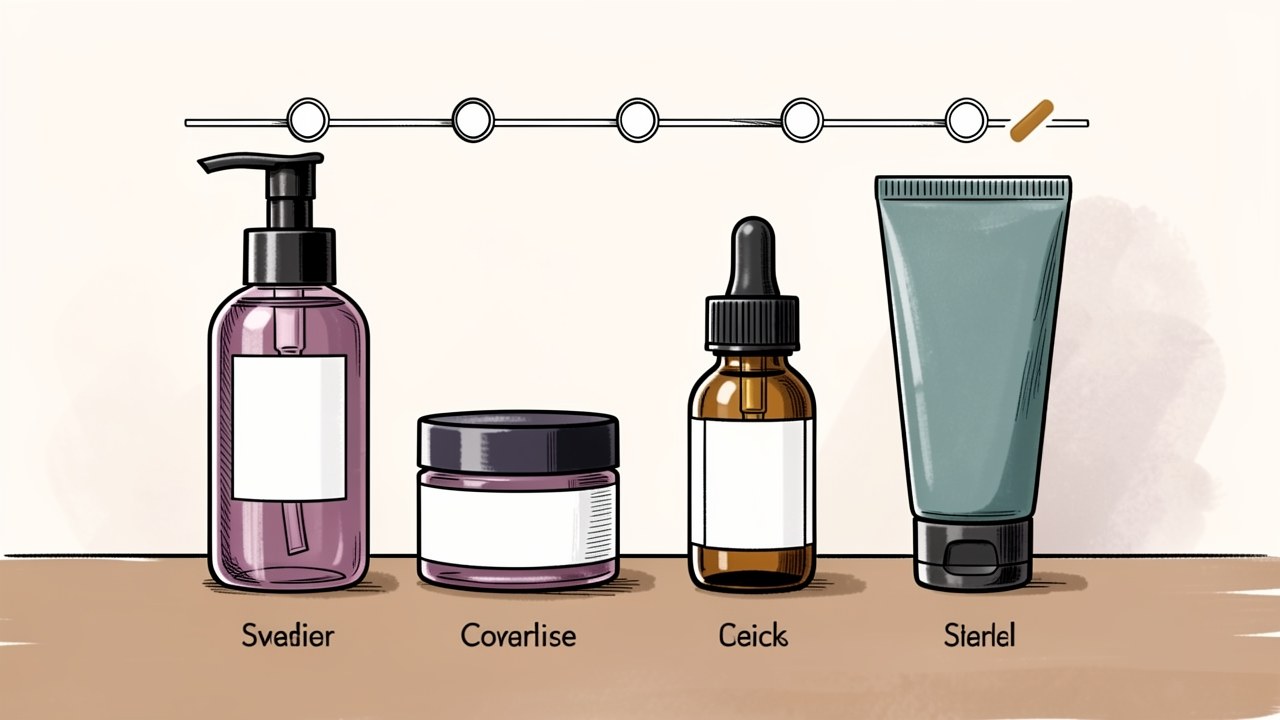
Core skincare categories and what each does
Skincare products are easiest to coordinate when you group them by the job they perform rather than by brand or marketing language. The common retail groupings you will see in the United States include cleansers, moisturizers, eye treatments, treatment and serums, and suncare. These names describe how products are merchandised and talked about, not official legal classes.
The U.S. Food and Drug Administration does not publish a single mandatory taxonomy of skincare categories such as serum, toner or essence. What the FDA does define is whether a product is a cosmetic, a drug, or both, based on its intended use. Cleansers and moisturizers fit the cosmetic definition, while products intended to treat a condition or change the structure or function of the body fall under the drug definition.
- Cleansers: remove surface oil and debris so the rest of a routine can be applied to clean skin.
- Moisturizers: help skin feel softer and look smoother by reducing water loss and adding a comfortable finish.
- Treatments and serums: target a specific concern, often with a lighter texture than a cream.
- Eye treatments: smaller-format products positioned for the thinner skin around the eyes.
- Suncare: products whose primary job is protection from ultraviolet exposure.
Sources: U.S. Food and Drug Administration (FDA), Ulta Beauty
Cleansing, moisturizing and protecting as the base
Three jobs form the practical foundation of almost any skincare routine: cleansing, moisturizing and protecting. They are not glamorous, but they make the rest of your products easier to use consistently. A cleanser removes what has built up on the skin, a moisturizer helps keep skin comfortable, and sun protection limits ultraviolet exposure. In U.S. regulatory terms, a plain moisturizer and a non-soap cleanser are cosmetic products because they are applied for beautifying or cleansing purposes.
The protecting step is where category language becomes more interesting. Sunscreens are treated as over-the-counter drugs in the United States because of their therapeutic function, and sunscreen ingredients have their own OTC monograph. A moisturizer marketed with sun-protection claims is a cosmetic and drug combination product. That dual identity does not make it harder to use, but it does explain why the label may look different from a plain lotion.
- Cleanse to remove buildup without stripping the skin.
- Moisturize to keep the skin comfortable and reduce a tight or rough feeling.
- Protect with suncare when ultraviolet exposure is part of your day.
Sources: U.S. Food and Drug Administration (FDA), Cosmetic Science (cosmeticscience.net)
Where treatment-oriented steps fit and when they matter
Treatment-oriented products are the steps that target a specific concern rather than simply maintaining comfort. This is where the U.S. cosmetic and drug distinction becomes most useful. A product that claims to improve the appearance of fine lines or visibly brighten skin tone is making an appearance-based cosmetic claim. A product that claims to stimulate collagen production, treat acne and eliminate breakouts, or reverse sun damage and repair DNA is making a drug claim because it describes a biological change or a medical condition.
In the United States, topical skincare can be regulated as a cosmetic, as an over-the-counter drug, or as a prescription drug. Sunscreens, antiperspirants and anti-acne products are treated as OTC drugs because of their therapeutic function. Anti-dandruff shampoos are another dual case: they cleanse hair like a cosmetic but treat dandruff like a drug. Knowing which category a treatment belongs to helps you expect the right labeling and claim language.
- Appearance claims describe how skin looks; biological-change claims describe what happens inside the skin.
- OTC drug status usually means a Drug Facts panel and monograph compliance.
- Cosmetic-only products generally do not need pre-market approval except for color additives.
- The term cosmeceutical has no meaning under U.S. law.
Sources: U.S. Food and Drug Administration (FDA), The Eco Well, Cosmetic Science (cosmeticscience.net)
How skincare categories map to hair-care and fragrance steps
The same coordination logic you use for skincare applies to hair care and fragrance. Retailers commonly list hair-care categories as shampoo and conditioner, treatment, and styling products. Shampoo cleanses hair, conditioner and treatments follow, and styling products shape the finished look. Fragrance is usually applied after other products have settled; check product-specific usage guidance for the exact placement in your routine.
In U.S. regulatory terms, ordinary cleansing shampoos are cosmetics, while antidandruff shampoos are cosmetic and drug combination products because they also treat dandruff. Perfumes fall under the FDA cosmetic definition. That shared framework makes it easier to think about a whole routine: each category has a job, and the order follows the job rather than the brand.
- Skincare: cleanse, moisturize, protect, then treat as needed.
- Hair care: cleanse, condition, treat, then style.
- Fragrance is often applied after other products have settled; check product-specific usage guidance.
Sources: U.S. Food and Drug Administration (FDA), Ulta Beauty
Reading a skincare label for category rather than brand
Brand names and packaging are designed to sell, but the label tells you what the product is intended to do. Read the claims first: is the product promising to cleanse, beautify, promote attractiveness or alter the appearance, which are cosmetic uses, or is it promising to treat, cure, mitigate or prevent a condition, which are drug uses? If a single product promises both, it may be a cosmetic and drug combination product. Antidandruff shampoo is the classic example, because it cleanses hair and treats dandruff.
Ingredient lists alone do not reliably predict how a finished formula will perform. One INCI name can represent many different ingredients, and the same ingredient list can correspond to different concentrations and manufacturing techniques. How an ingredient performs is formulation-specific, so the category and the intended-use claims are usually more useful for placement than the ingredient list alone. Claims evidence also varies in strength: objective instrumental or clinical measurements provide verifiable data, subjective consumer-perception studies reflect perceived benefit, and the strongest claims combine both types of evidence.
- Check whether the product makes cosmetic appearance claims or drug treatment claims.
- Look for a Drug Facts panel if the product is an OTC drug.
- Treat the ingredient list as context, not a prediction of performance.
- Use the category to decide where the product fits in your routine.
Sources: U.S. Food and Drug Administration (FDA), The Eco Well
U.S. regulatory categories that shape what you buy
The Federal Food, Drug, and Cosmetic Act defines cosmetics as articles intended to be rubbed, poured, sprinkled or sprayed on, introduced into, or otherwise applied to the human body for cleansing, beautifying, promoting attractiveness or altering the appearance. The FDA lists skin moisturizers, perfumes, lipsticks, fingernail polishes, makeup, cleansing shampoos, permanent waves, hair colors and deodorants as examples. The same act defines drugs by intended use, including articles intended for the diagnosis, cure, mitigation, treatment or prevention of disease, and articles other than food intended to affect the structure or any function of the body.
A product can be both a cosmetic and a drug if it has more than one intended use. The FDA gives antidandruff shampoo as an example: it cleanses hair and treats dandruff. Other combinations the FDA lists include toothpastes containing fluoride, deodorants that are also antiperspirants, and moisturizers and makeup marketed with sun-protection claims. Cosmetic products and ingredients, except color additives, do not require FDA approval before going on the market, while drugs generally must either receive premarket approval through the New Drug Application process or conform to an FDA OTC monograph.
| Category | Regulatory basis | Example skincare types | Pre-market approval |
|---|---|---|---|
| Cosmetic | Applied for cleansing, beautifying, promoting attractiveness or altering appearance | Moisturizers, cleansing shampoos, perfumes, makeup, deodorants | Not required, except for color additives |
| OTC drug | Intended use includes treatment, prevention or affecting body structure or function | Sunscreens, anti-acne products, antiperspirants | Premarket approval or OTC monograph conformance |
| Cosmetic and drug combination | Product has more than one intended use | Antidandruff shampoo, moisturizers with sun-protection claims, deodorant-antiperspirants | Must comply with both cosmetic and drug requirements |
Sources: U.S. Food and Drug Administration (FDA), Cosmetic Science (cosmeticscience.net)
When fewer categories are enough
A working routine does not require every category on a shelf. If your skin feels comfortable and you are protecting it from sun exposure, you may not need a separate treatment or serum. The FDA notes that cosmetic products generally do not require pre-market approval, and ordinary skincare items such as moisturizers, cleansers and exfoliants are not subject to that approval, though they must comply with labeling rules and avoid false or misleading claims. That means you can simplify without worrying that you are missing a regulatory step.
The deeper point is that categories exist to serve jobs. If the job is already covered, adding another category is optional. If a product claims to treat a condition, it moves into drug territory and carries different labeling. Reading the claims and the category together lets you decide whether a new product actually adds something your routine does not already do.
- Skip treatments if your main concern is comfort and protection.
- Choose a combination product when you want one step to do two jobs.
- Reassess categories when your skin or routine changes.
Sources: U.S. Food and Drug Administration (FDA), Aurora Global Brands (auroracos.com)
Frequently asked questions
Do I need every skincare category to have a working routine?
No. A routine can be effective with just cleansing, moisturizing and protecting. Treatments and serums are optional additions that target specific concerns, and they make sense only when you have a concern that the base steps do not already address.
Sources: U.S. Food and Drug Administration (FDA)How do I tell whether a product is a cleanser, treatment or moisturizer?
Read the intended-use claims on the label. A cleanser will say it cleanses or washes; a moisturizer will say it moisturizes, hydrates or softens; a treatment will describe a specific concern, such as acne or the appearance of fine lines. If the claim describes treating a condition or changing the body, the product may be regulated as a drug.
Sources: U.S. Food and Drug Administration (FDA), The Eco WellCan one skincare product replace two categories?
Yes, if it is a combination product. A moisturizer marketed with sun-protection claims is a cosmetic and drug combination, and an antidandruff shampoo cleanses hair while treating dandruff. These products must meet the requirements for both categories, which is why the label may include both cosmetic and drug information.
Sources: U.S. Food and Drug Administration (FDA)Are sunscreens and anti-acne products considered cosmetics?
No. In the United States, sunscreens, antiperspirants and anti-acne products are treated as over-the-counter drugs because of their therapeutic function. They must either receive premarket approval through the New Drug Application process or conform to an FDA OTC monograph.
Sources: U.S. Food and Drug Administration (FDA), Cosmetic Science (cosmeticscience.net)What does MoCRA change for skincare products?
The Modernization of Cosmetics Regulation Act of 2022 amended the Federal Food, Drug, and Cosmetic Act to add the term cosmetic product and to require cosmetic product facility registration and cosmetic product listing, with certain small-business exemptions. MoCRA also requires the FDA to establish good manufacturing practice requirements for facilities that manufacture or process cosmetic products distributed in the United States, with a statutory deadline not later than December 29, 2025.
Sources: U.S. Food and Drug Administration (FDA), Cosmetic Science (cosmeticscience.net)Does the FDA recognize the term cosmeceutical?
No. Under U.S. law, a product can be a drug, a cosmetic, or a combination of both, but the term cosmeceutical has no meaning. Products marketed with that term still fall into one of the recognized categories.
Sources: U.S. Food and Drug Administration (FDA)Is traditional soap regulated the same way as skincare?
No. Traditional soap has its own regulatory category separate from cosmetics and is regulated in the United States by the Consumer Product Safety Commission, not by the FDA. A cleanser that is not traditional soap may fall under the FDA cosmetic definition instead.
Sources: U.S. Food and Drug Administration (FDA)Sources
- Is It a Cosmetic, a Drug, or Both? (Or Is It Soap?) — U.S. Food and Drug Administration (FDA)
- Classification of Cosmetic Products in the USA | Cosmetic Science — Cosmetic Science (cosmeticscience.net)
- A 101 guide to skincare claims — The Eco Well — The Eco Well
- FDA Skincare Rules: Cosmetic vs. Drug Explained — Aurora Global Brands (auroracos.com)
- Skincare Guides: Best Skincare Products & Routines — Ulta Beauty